Technology licensing
Our real-time engines, yours to license
Real-time engines and libraries built at SAT, available to license for your own products.
At SAT's Innovation department. Photo: Felix B.
For over twenty-five years, SAT has built real-time engines for immersive creation. The code that runs our tools is available to license. Put it inside your own products and installations.
Four engines to license
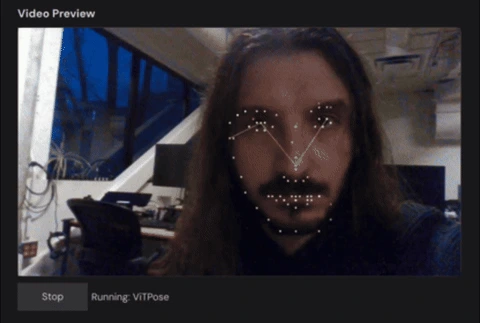
Real-time neural inference engine
Runs vision and language models on the GPU, in C++, over ONNX Runtime and TensorRT.
A C++ engine that runs neural networks on the GPU, on top of ONNX Runtime and TensorRT. It takes care of the tensor and texture plumbing: hand it a camera or video frame, get structured data back. The bundled models cover body pose (BlazePose, RTMPose, YOLO-pose), object detection and segmentation (YOLO), depth (Depth Anything), classification (ResNet), image generation (GANs), and vision-language tasks.
Application domains
- Real-time video analysis
- Pose and object detection
- Segmentation and depth
- AI-augmented interaction
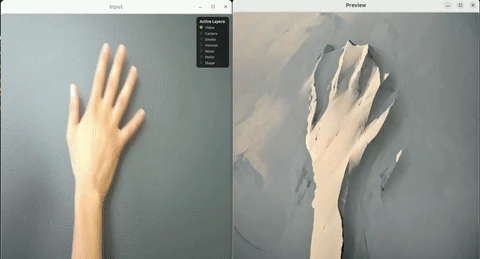
Real-time generative image engine
StreamDiffusion in C++/CUDA/TensorRT. Generates images live, from text or video.
LibreDiffusion is a C++/CUDA/TensorRT build of StreamDiffusion. It generates images in real time from a text prompt or an incoming video frame, and compiles diffusion models (SD 1.5, SDXL, SD and SDXL Turbo, SDXS, FLUX.2-klein) into TensorRT engines. LoRAs, ControlNets, and IP-Adapters all work. On current hardware it keeps pace with a live video feed.
Application domains
- Live generative visuals
- Scenography and installations
- AI-assisted creation tools
- Visual prototyping
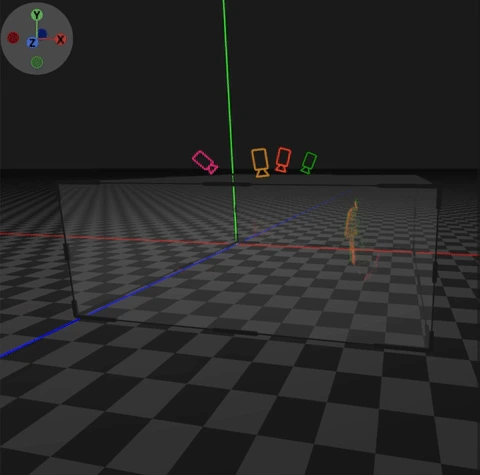
Point cloud compression and transfer
A C++ codec for point clouds. Encode a frame, send the bytes, decode on the far side.
PCCL compresses point cloud geometry and moves it over the network. The encoder packs a frame of xyz positions into a small, self-describing buffer; the receiver decodes it. Its README clocks encode and decode at 100 to 300 times faster than MPEG G-PCC. For continuous streams it can pin one quantization grid across every frame, and a relay can read a packet's header to route or transcode it without decoding. The target is live LIDAR and volumetric capture.
Application domains
- Real-time LIDAR
- Volumetric capture
- Point cloud transport
- Telepresence and digital twins
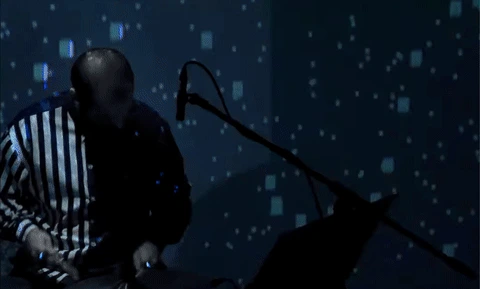
Gesture and biosignal library
C++ gesture recognizers and biosignal analysis for instruments and interactive devices.
This C++ library, from the Puara ecosystem, turns sensor and biosignal data into events you can act on. It recognizes instrument gestures (jab, shake, tilt, roll) and reads biosignals like heart rate, skin conductance, EEG power bands, and evoked potentials. The layer underneath is plain signal processing: scalers, normalizers, peak detectors, leaky integrators, PCA, correlation. All of it fits on embedded hardware.
Application domains
- Digital musical instruments
- Gestural interfaces
- Biometric sensing
- Embedded devices
Made for real-time production
Immersive venues and domes
Interactive installations
Live shows and broadcast
Research and education
And more
These four are part of a larger toolbox: spatial audio, computer vision, network protocols, embedded tooling. Tell us what you're after; chances are a piece already exists.
Want to license one?
Tell us about your project. We'll work out what fits and how to license it.
Contact ussuite@sat.qc.ca